
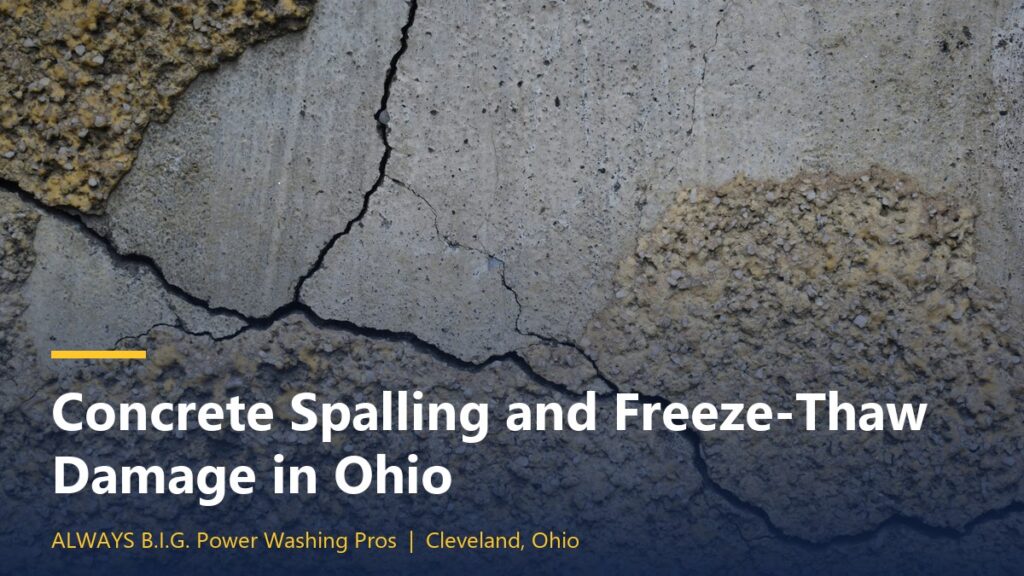
Quick answer: spalling is when the surface of concrete flakes, chips or peels away. In Northeast Ohio, it is usually caused by water soaking into the concrete and then freezing and expanding, made worse by road salt, poor drainage and weak or poorly finished concrete. You cannot reverse spalling by cleaning, but you can slow it with sealing, drainage and careful winter habits.
If your driveway or steps look pitted and rough after winter, you are probably seeing spalling. It is one of the most common forms of concrete damage in cold climates like ours.
What spalling looks like
- Small flakes or scales peeling off the surface
- Pitting that exposes the stones in the mix
- Rough, crumbly patches
- Chips breaking off at edges and joints
Spalling is different from a simple crack. It usually affects the top layer, although deep spalling can expose rebar.
What causes it
Freeze-thaw cycles
Water seeps into the pores. When it freezes it expands by about 9 percent, which creates pressure inside the concrete. Over repeated cycles, the surface breaks apart. Northeast Ohio has many freeze and thaw days each winter.
De-icing salts
Salt does not cause the damage by itself, but it increases the number of freeze and thaw cycles, draws more moisture into the surface and can chemically attack concrete. Some de-icers containing ammonium nitrate or ammonium sulfate can be especially damaging.
Poor concrete quality or finishing
Concrete poured too wet, finished while bleed water was still rising or without air entrainment is more vulnerable.
Drainage problems
Slabs that do not drain, or that sit in wet areas below downspouts, stay saturated and freeze deeper.
Pouring or sealing too late in the season
Concrete that has not cured before winter is more susceptible.
Can cleaning make spalling worse?
Aggressive pressure washing can remove loose scale but also cause more damage when it hits weakened concrete. Gentle surface cleaning is safer, and a professional can adjust the method to the condition of the surface. If you see flaking, tell your cleaner before they start.
How to slow the damage
- Keep concrete clean. Dirt, algae and salt residue hold moisture on the surface.
- Seal appropriately. A penetrating sealer can reduce water and salt absorption. See sealing prep.
- Improve drainage. Make sure downspouts and grading send water away from slabs.
- Use de-icers wisely. Shovel first, use as little as needed and avoid ammonium-based products.
- Sweep up leftover salt. In spring, sweep and rinse residue away.
- Repair cracks early. Seal small cracks before water gets in.
When to repair or replace
| Condition | Typical response |
|---|---|
| Light surface scaling | Clean, repair with a resurfacer, then seal |
| Widespread flaking | Resurfacing overlay by a concrete contractor |
| Deep spalling, exposed rebar | Repair or partial replacement |
| Sunken or heaved slabs | Concrete contractor evaluation |
Concrete repair is a job for a concrete contractor. We focus on cleaning, which is often the first step so they can see the true condition of the surface.
Winter habits that help
- Shovel snow early so less salt is needed
- Do not pile salty snow against the slab
- Use sand for traction where possible
- Rinse salt off in spring
Clean before you repair
Cleaning exposes cracks, scaling and stains so repairs are targeted. It also removes contaminants that would prevent a repair product or sealer from bonding. Our concrete cleaning starts at $0.23 per square foot, and our guide on road salt and winter stains explains spring cleaning in more detail.
Frequently Asked Questions
What is the difference between spalling and scaling?
Scaling is the loss of a thin surface layer, while spalling often refers to deeper flaking or chipping. People often use the terms together.
Does salt ruin concrete?
Repeated salt exposure speeds freeze and thaw damage and can attack the surface, especially on newer or poorly finished concrete.
Can spalled concrete be fixed?
Light spalling can often be repaired with a resurfacer. Severe damage may need removal and replacement.
Should I seal concrete to prevent spalling?
A quality penetrating sealer helps reduce water and salt absorption, but it does not repair existing damage.
Can pressure washing damage weak concrete?
Yes, if the pressure is too high. Use a surface cleaner and controlled settings, especially on older slabs.
Related reading
- Road Salt, Rust and Winter Stains: Restoring Your Concrete Driveway in Cleveland
- Pressure Washing a Driveway Before Sealing: Why Prep Decides How Long the Sealer Lasts
- Slippery Sidewalks and Walkways: How Cleaning Reduces Slip Hazards Around Your Home or Business
Get a Free Quote from ALWAYS B.I.G.
Ready to put this to work? Use the instant estimate on our site, book online in a few clicks, or call or text (216) 202-8264. We serve homeowners and businesses across Cleveland and Northeast Ohio.
About the Author
Michael Betts is the founder of ALWAYS B.I.G. Power Washing Pros, an owner-operated exterior cleaning company serving homeowners and businesses across Cleveland and Northeast Ohio with house washing, roof cleaning, gutter services, window cleaning and concrete cleaning.
Call or text (216) 202-8264, email michael@ohiopowerwashingpros.com, or read more homeowner guides in the Curb Appeal Report.